Funds saving plan

Your money deserves to earn more than low interest. With the funds saving plan, you regularly invest a fixed amount in funds – as easily as setting up a standing order and with higher potential returns in the long term.

The funds saving plan: get started easily, stay flexible

  • From as little as 20 francs
    A small amount is sufficient. Invest at your own pace – and gain initial investment experience.
  • Funds for every type of investor
    There are over 50 funds to choose from – for every goal and need. You decide what suits you best.
  • Your plan, flexible at all times
    You decide how much to pay into your funds saving plan and how often. You can change, pause or stop it anytime.
  • Get more out of your money
    If you invest regularly, you can achieve more in the long term than with a savings account – and you don’t have to worry about the right time to invest.

Get more with regular inpayments

These days, investing’s just as easy as saving. With a funds saving plan, you have a higher potential long-term return than with a savings account. Because you invest regularly, price fluctuations are evened out over time – automatically with the cost averaging effect.
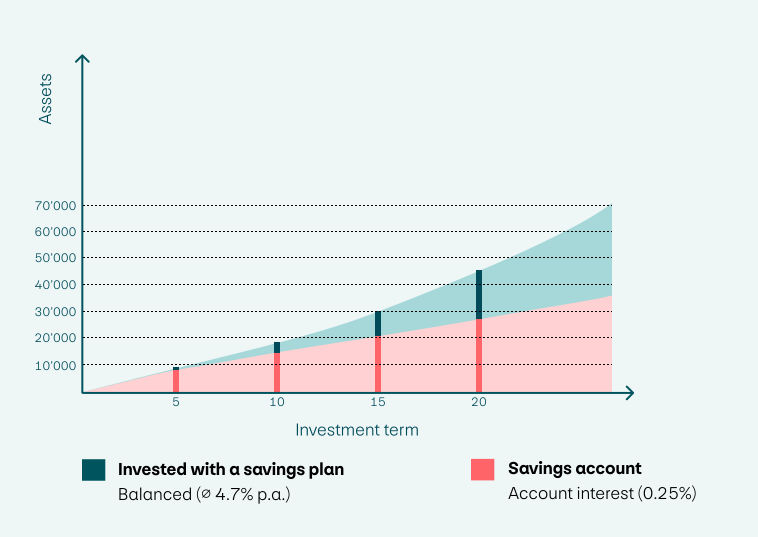
Graphic illustrates the example given below
Example: You invest 2,000 francs on a one-off basis and then 100 francs a month in securities. With an average return of 4.8 percent, your final capital after 20 years would amount to 44,806 francs. For a savings account with an interest rate of 0.25 percent, the amount would be 26,706 francs with the same inpayments. In other words, with a funds saving plan, you achieve around 18,100 francs more. Inflation is not taken into account in this calculation.

This is an example. We assume 0.25 percent interest on the savings account, while past performance based on index data, minus administrative fees, custody charges and ETF costs since 2010, has been used for forecasts (net return). This calculation is no guarantee of future market performance. The actual value achieved by the asset may differ significantly from the forecasts.

Set up in three steps

You decide what’s right for your funds saving plan – and can adjust, pause or stop the plan anytime.

  1. Choose from 15 PostFinance Fonds and more than 40 third-party funds – to suit every risk tolerance and every need.

  2. Decide how much you want to invest and how often.

  3. Your funds saving plan runs automatically. You retain full control and can make changes immediately.

Valued by our customers

Every second person who invests independently in funds at PostFinance uses a funds saving plan.

Set up a saving plan

You already have a fund custody account? Set up your saving plan in just a few clicks.

Open custody account

You don’t have a fund custody account yet? Open the fund self-service custody account online and get started right away.

Set up a saving plan

You already have a fund custody account? Set up your saving plan in just a few clicks.

Open custody account

You don’t have a fund custody account yet? Open the fund self-service custody account online and get started right away.

Frequently asked questions

  • With a funds saving plan, you regularly invest a fixed amount in funds. This allows you to build up assets gradually, pursue a personal investment goal and have the opportunity to participate in developments on the capital markets over the long term. A funds saving plan is suitable both for asset growth and as additional capital for private retirement planning.

  • A savings account offers security, but usually low returns if inflation, or rather the rate of inflation, is higher than the interest rate. A funds saving plan invests in shares, bonds or other asset classes, offering significantly higher potential returns in the long term. With a suitable investment strategy, opportunities and risks can be individually tailored to your savings goal.

  • If you make regular inpayments, you benefit in several ways: your money grows, and your returns are reinvested and added to it (compound interest effect). The longer you keep it going, the greater the effect can be.

  • If you invest regularly, you automatically purchase more fund units when prices are low and fewer when prices are higher. This principle is known as the cost averaging effect. This reduces the risk of entering the market at an unfavourable time – regardless of how the markets stand. A funds saving plan helps you to save continuously.

  • Your money is invested broadly in many different investments within the fund (diversification). The capital is distributed across different securities, sectors and regions. This allows fluctuations in individual investments to be evened out.

  • You can modify, pause or increase your inpayment anytime. Additional inpayments are also possible. This means the funds saving plan remains flexible – no matter how your life situation changes.

  • Yes, a funds saving plan is suitable for both long-term asset growth and retirement planning – as additional capital on top of the existing retirement savings products. Long-term goals in particular can help to even out market fluctuations and consistently harness growth potential.

  • Yes, you can withdraw money from the fund as you wish – either in the form of individual outpayments or by withdrawing everything at once. You can continue to adapt the strategy to your investment goal.

  • ETF saving plans are usually managed independently. A funds saving plan usually includes personal advice, a structured analysis of your goals, as well as individually tailored fund selection and ongoing support.

    Both work in a similar way – the difference is in the investments:
    with an ETF saving plan, you invest in ETFs that reflect a market.
    A funds saving plan invests in selected funds, e.g. from PostFinance or other providers.

  • That depends on your needs. A personal investment consultation can be helpful if you would like support with selecting funds or with topics such as investment strategy, savings goal or risk profile. With fund consulting basic, you receive a suitable recommendation and can benefit from a consultation if required. If you prefer to make your own decisions, you can use the fund self-service without a consultation.

This might interest you too